Prior Weeks
On this page are the work shops from the weeks before.
Current Week
Story Structures:
What is story structure?
Story structure is the order in which plot events are told to the reader or audience. While stories can be told in a wide variety of ways, most Western story structures commonly share certain elements: exposition, rising action, climax, falling action, and resolution.
A tightly controlled structure will answer a reader’s questions, provide a climax followed by resolution and information at the end of the story, further the characters’ development, and unravel any central conflicts. In other words, it’s responsible for a satisfying narrative experience that accomplishes the author’s aims.
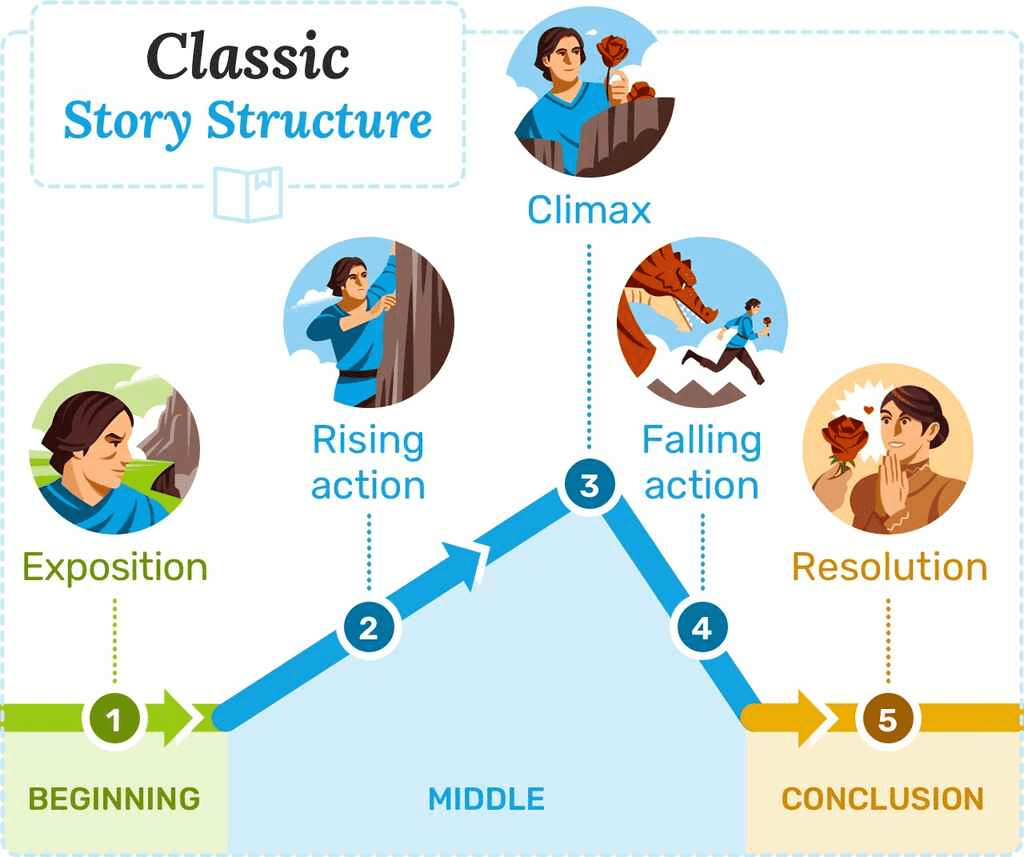
Classic story structure
When people discuss different story structures, they often talk about the different frameworks used to analyze stories. When you boil them all down, all stories have certain shared elements.
Elements of classic story structure:
- Exposition. This first part establishes a protagonist’s normal life and greater desires, and usually culminates in the inciting incident.
- Rising action. The protagonist pursues their new goal and is tested along the way.
- Climax. Our hero achieves their goal — or so they think!
- Falling action. The hero now must deal with the consequences of achieving their goal.
- Resolution. The conclusion tying together the plot, character arcs, and themes.
These are all common ‘beats’ to most stories. It can be easier to see these moments in genres with higher stakes (such as a military thriller), but you’ll find them in almost any type of story.
In Medias Res
As most people who teach about in medias res will tell you within four seconds, “in medias res” is Latin that translates to “in the midst of things.” In some ways, this is pretty straightforward: Instead of starting a story with exposition or setup, you start with the action or conflict. Most people will cite that this will grab the reader and draw them into the story.
in medias res means cutting off the exposition and setup, it also means cutting off the context. If I have no clue who to care about, how we got here, and why what is happening matters, it can be really difficult to get invested in the story.
When you start in medias res, the audience lacks context.
In this way, beginning in medias res is a lot like writing a teaser, which also works off a lack of context. In a teaser, the whole point is to tease the audience through a lack of context. The teaser promises that if the audience keeps reading, they will get more context to understand what just happened. This is often a great way to use in medias res.
But just like a teaser, the audience won’t stick around if context is withheld from them for too long.

A classic example of this plot type is The Wizard of Oz. In the beginning of the story, Dorothy’s life is above the midpoint on the GI-Axis. Yes, Kansas is monochromatic and dull. But she is loved and well cared for by Aunt Em and Uncle Henry. The three farm hands are quite fond of her and entertain her as they work. She and Toto play all day. Her life might be a bit boring, but it’s above zero on the GI-Axis. When Miss Gulch takes Toto away, she dips down. When Toto returns but she has to run away to protect him, she dips further. When she’s told her aunt is sick because she left, she dips more. Then the tornado, then the Wicked Witch chasing her, then being given an impossible task, then being captured. Even once she’s beaten the witch, has given the wizard the broomstick, and has discovered his ruse, her problems never seem to end—he promises to take her home in his balloon, but Toto chases a cat and he floats away without her. She’s out of options. A true low point. Until Glenda teaches her the final lesson and she goes home, happier to be there than she was before. (Higher on the GI-Axis than she was at the beginning of the story.)

The classic example of this plot type is Cinderella. That’s how this plot type got its name, after all. In the beginning, Ella’s mother has died and her father has remarried. Her stepmother is awful to her, as are her stepsisters, and she’s relegated to a servant in her own home. She sleeps at the hearth for warmth because she doesn’t even have a blanket (hence the name Cinder-Ella, she sleeps among the cinders). The king announces a ball for his son, the prince, to meet his bride, and though she has to help her stepsisters get ready, she is forbidden to attend. Once her family leaves, her fairy godmother appears and helps her get ready. Of course, there’s a catch. The magic only lasts until midnight. She has a grand time at the ball and enchants everyone there. Her own family doesn’t recognize her, she cleans up so well. And she’s having such a wonderful evening, she doesn’t notice the time. When the clock strike twelve, she flees so quickly, she leaves behind a shoe. And that’s how the prince finds her later. Then they live happily ever after.

Of course, it doesn’t last. That’s why the graph plummets. And it nosedives past the midpoint of the GI-Axis and into the dark part. Something caused the happy couple to split. It might have been something easily rectified, like a miscommunication. It might have been something serious, like a family feud. But in the middle of this story, they’re torn apart. Only toward the end do they reconcile, and the resolution sees the graph much higher than the beginning, because together they are far happier than the hero was when he started alone.
A classic example of this plot type is Grease. In the beginning of the story, Danny is already happy. He’s about to be a senior, he’s got a group of close friends of which he’s the leader, and he’s popular at school. Things could always be better (he could be richer, he could be smarter, he could be liked by even more people), but he’s perfectly happy with how things are. But then he meets Sandy. And he has an amazing summer romance. He thinks he has to give her up because she’s going back to Australia. Then he forces himself to give her up because of his friends. Even when he tries to make it work, it seems too hard to overcome all the obstacles. They’re both miserable. But then he decides to become an athlete and leave the T-Bird life behind for her. (Luckily, she doesn’t make him and makes opposite changes for him.) They get their happily ever after ending, much higher on the GI-Axis than where they started.
In Summation:
- Starts happy
- Meets Sandy and is happier
- Loses her and is sad
- Has to choose between her and his friends
- Makes the tough choice and starts to get happy
- Gets her and his friends; immeasurable happiness

The classic example of this plot type is Kafka’s The Metamorphosis. The story begins with a traveling salesman, Gregor, who is completely unhappy with his life and his job. He would quit, but his family depends on his salary. When he wakes, he finds he has transformed into a disgusting insect overnight. He is uncomfortable, but in his current form, he’s unable to roll off his back. He’s missed his train to work, and he’s unable to speak when his family and office manager call out to him. When he finally manages to open his door, they are horrified by his appearance, lash out at him, and close him in his room. The food they give him repulses him, but he finds he enjoys rotting scraps. No one visits, and while he spends all his days alone, listening to his family lament the difficult situation he’s put them in, he finds himself literally climbing the walls. His father throws an apple at him when he mistakes his concern for his mother as an attack. His sister grows to resent caring for him. His whole family ceases to acknowledge him at all, focusing only on what he’s cost them and not on what he’s going through or on what he’s given up or what he’d once done for them. When he overhears them wishing he was dead, he retreats to his room for a final time and dies, alone and unloved. His family moves to the country with the money they saved living meager lives while hiding him from the public, and he reaps none of this good fortune (as he’s dead and gone, and his family didn’t even bury him; the maid disposed of his body for them).
In Summation:
- Starts miserable
- Things get worse
- Ends at the pinnacle of badness

Then he’s going along, being faced with choices and making them. But he doesn’t know the results of those choices. And by the end of the story, he still doesn’t know.
The classic example of this plot type is Hamlet. The reason this is a Good News/Bad News story is because Hamlet goes through the entirety of the play not knowing whether any information he receives is good news or bad, nor does he know whether any decision he makes will result in a good or bad outcome.
He begins the story in the same place Cinderella did, well below the midpoint of the GI-Axis. He’s been summoned home because his father is dead, and his mother has remarried his uncle. When he arrives, his friend tells him to go to the roof, where he sees his father’s ghost and is told his uncle, Claudius, killed him for the throne. But there’s no way to prove this. So, Hamlet has Rosencrantz and Guildenstern put on a play reenacting the crime so he can study his uncle’s reaction. Surely seeing his transgressions on stage will cause his guilty conscience to manifest in some way. But it doesn’t. He doesn’t react at all. This confuses Hamlet, who goes to his mother’s chambers, agitated and confused. When he sees someone hiding behind her draperies, he believes it to be his uncle and takes decisive action, striking him dead through the curtain. But it’s Polonius (who Hamlet doesn’t like, anyway). But Polonius’s daughter, Ophelia, whom Hamlet loves, kills herself upon hearing the news. These deaths result in a duel between Hamlet and Polonius’s son, Laertes. Claudius has it rigged so Hamlet will die either way—by poison sword-tip if he’s stabbed or by poisoned chalice if he wins. Unfortunately, he is winning the duel but he refuses the drink and his mother takes the cup, instead, and dies instantly. Laertes, who gets cut by his own poisoned blade, wounds Hamlet then reveals the plan to him. Hamlet runs his uncle through with the toxic sword, then (adding insult to injury) also makes him finish the poisoned wine. His father finally avenged, and now his mother avenged, too, Hamlet can die at peace with his choices, though he still doesn’t know whether any of his decisions made a difference.
In Summation:
- His father is dead and his mother remarried his uncle.
- The ghost of his father tells him to avenge him. (Do we know if this is true? No.)
- Stage a play to test veracity of claim. (Does this work? No.)
- In mother’s room, sees drapes wave. Thinks it’s his uncle. Stabs him. (Does this avenge his father? No. It’s Polonius.)
- Ends up in a duel. Dies. Good news or bad? We still don’t know until we know if he ends up in Heaven, Hell, or if there’s no afterlife at all.
- This is a masterpiece because Shakespeare told us a story that represents the truth of life. It’s all unknown.
Vonnegut gave several speeches over the years, and politics aside, he was an engaging and entertaining speaker. His talks on the five basic plots were particularly humorous. I’m including one such video here at the end of this post. It’s not too long, and I hope you take the time to watch it.
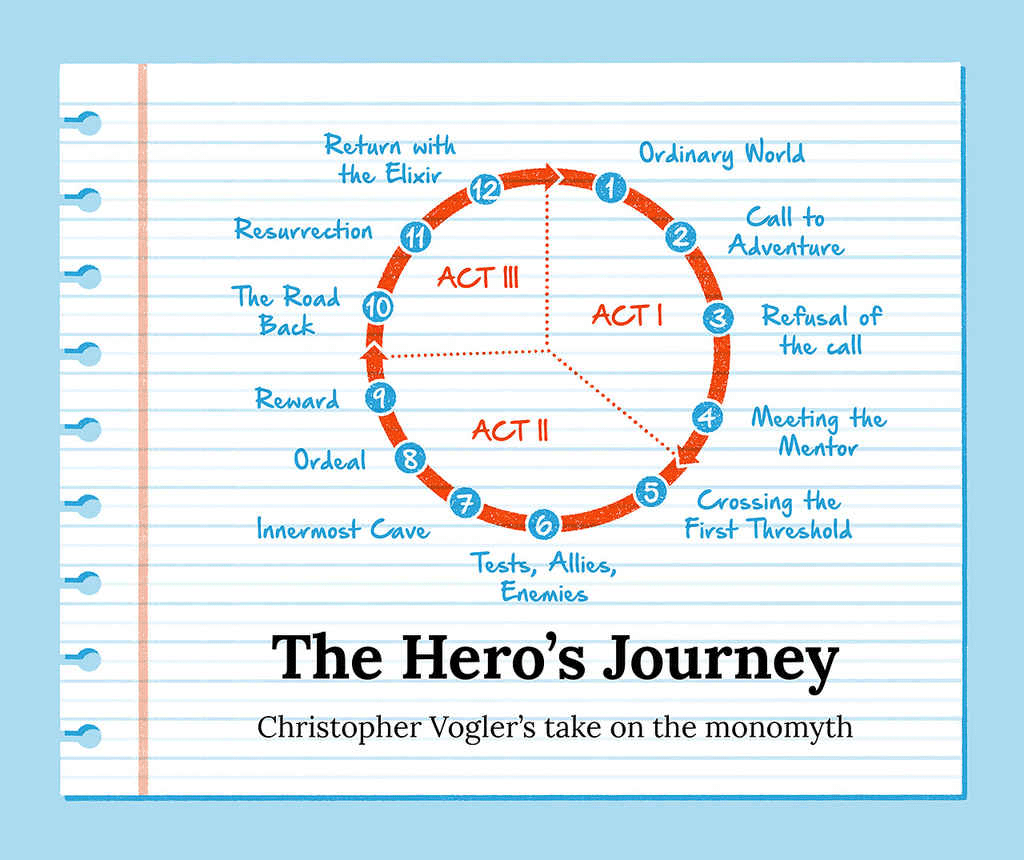
Inspired by Joseph Campbell’s concept of the monomyth — a storytelling pattern that recurs in mythology all over the world — The Hero’s Journey is today’s best-known story structure. Some attribute its popularity to George Lucas, whose Star Wars was heavily influenced by Campbell’s The Hero With a Thousand Faces.
Campbell’s original structure uses terminology that lends itself well to epic tales of bravery and triumph — with plot points like “Belly of the Whale,” “Woman as the Temptress,” and “The Magic Flight.” To make The Hero’s Journey more accessible, Disney executive Christopher Vogler created a simplified version that has become popular amongst mainstream storytellers.
Structure
- The Ordinary World. The hero’s everyday life is established.
- The Call of Adventure. Otherwise known as the inciting incident.
- Refusal of the Call. For a moment, the hero is reluctant to take on the challenge.
- Meeting the Mentor. Our hero meets someone who prepares them for what lies ahead — perhaps a parental figure, a teacher, a wizard, or a wise hermit.
- Crossing the First Threshold. The hero steps out of their comfort zone and enters a ‘new world.’
- Tests, Allies, Enemies. Our protagonist faces new challenges — and maybe picks up some new friends. Think of Dorothy on the Yellow Brick Road.
- Approach to the Inmost Cave. The hero gets close to their goal. Luke Skywalker reaches the Death Star.
- The Ordeal. The hero meets (and overcomes) their greatest challenge yet.
- Reward (Seizing the Sword). The hero obtains something important they were after, and victory is in sight.
- The Road Back. The hero realizes that achieving their goal is not the final hurdle. In fact, ‘seizing the sword’ may have made things worse for them.
- Resurrection. The hero faces their final challenge — a climactic test that hinges on everything they’ve learned over their journey.
- Return with the Elixir. Having triumphed, our protagonist returns to their old life. Dorothy returns to Kansas; Iron Man holds a press conference to blow his own trumpet.
While Vogler’s simplified steps still retain some of Campbell’s mythological language with its references to swords and elixirs, the framework can be applied to almost any genre of fiction. To see how a ‘realistic’ story can adhere to this structure, check out our guide to the hero’s journey in which we analyze Rocky through this very lens.
How to outline a novel:
- 1. Choose your main character
- 2. Give your main character a big problem
- 3. Find a catalyst that sparks action
- 4. Set obstacles on their path
- 5. Define their biggest ordeal
- 6. Figure out a resolution
- 7. Pinpoint the character’s arc
- 8. Connect the end to the start of the story
- 9. Put your outline together
Quote of the week: Kurt Vonnegut liked to say that the mission of the artist is “to make people appreciate being alive at least a little bit.”
Week 2 – Good Dialogue vs. Bad Dialogue
Explore new ideas, share stories, and grow as writers. This page highlights weekly assignments and prompts to spark creativity within our Astoria community.
It’s hard to have a story without dialogue, especially since it’s extremely hard to have a compelling story without a character. Once you have one or more characters they tend to talk to each other. Now, are there stories out there without dialogue? I’m sure there are, but have you heard of them?
The Screwtape Letters
The Lord of the Barnyard
So it’s possible, but you really have to do something special. But why would you want to? Dialogue is a blast. There are some stories that are nothin g but dialogue.
They’re Made out of Meat
Now that is great if you can pull it off, but when you do that you really don’t have a setting, character description (unless you slip it in the dialogue) or even a plot (what’s the plot in Terry Bison’s They’re Made out of Meat?)
But if we are going to write a story with dialogue and we want to write dialogue that keeps our reader reading, it has to work for us. Dialogue, like anything we right, should do one of two things:
Move the story along
Describe Character.
In writing dialogue you want dialogue that feels natural and authentic while also advancing the plot or revealing something about a character. If a line of dialogue serves no purpose, chances are it will be bad dialogue. In fact, great dialogue does the opposite. It serves several purposes if possible. It can let the reader know what type of person they’re dealing with, and it can advance the story.
Most great dialogue comes from conflict – what are some of your favorite lines of dialogue in books or films?
Subtext
The difference between what a character says and what a character means.
Has anyone ever had an argument with a significant other or had to support someone who just went through a traumatic event and afterward ask, “Are you okay?”
“What does that other person says? “I’m fine.” or “I’m good.” or “yeah, sure.”
Do they mean that they are fine or good? No. What do they really mean? That’s the subtext. Us humans rarely say exactly what we mean. Have you ever read or watch a good story where one of the characters says exactly what they mean?
What is better dialogue?
“Go ahead. Make my day.”
Or
“I’m a morally ambiguous middle aged police officer with anger issues and I need to overcompensate with a gigantic gun and if you don’t listen to me I will shoot you.”
Jaws: “You’re gonna need a bigger boat.”
Subtext: I am scared to death because that is the largest shark I’ve ever seen and I’m a shark expert.
Gone with the Wind: “Frankly, my dear, I don’t give a damn.” or
“We’ve had a lot of ups and downs in our relationship and I’m a bit angry right now so I’m going to say goodbye.”
Now, do you believe that if dialogue lacks subtext it’s not good dialogue?
“Luke, I am your father.” That has zero subtext, but is a very memorable line that changes the entire story.
What makes Good Dialogue good?
Must sound natural for the character speaking. Tone.
It attacks of defends – characters are trying to learn or persuading another
Expresses Subtext
What makes Bad Dialogue bad?
No subtext, obvious, sounds cliche, no deeper meaning makes it dull
Melodramatic, over the top emotion, loud does not mean emotional, comes off as funny
Exposition, information that the characters already know. You’ve heard this when one character says to another “As you know…”
Forced Poetry – doesn’t sound natural and it’s only there to make the writer look smart
Poorly researched vernacular – “Yo, that new flick was lit. It was fire, for real, six seven, six seven, skibidi toilet!”
How to make a conversation a scene
In our books we have two real parts to our story. We have the exposition where you as the narrator are talking to the reader and telling them about the setting, about the people in the story, about the story itself, and this can be done by 3rd person omnipotent or third person close. You can also speak directly to your reader in a flashback or showing what your protagonist is thinking.
But if you want to make your dialogue great, have your character working while talking. Have them do something that reveals their character and moves the story along.
What do you know about the characters through the dialogue?
How does the dialogue move the story along?
10-15 minute Writing Prompt:
Tell us that you’re _______ without telling us that you’re _________.
You have ten minutes to have your protagonist want something. They want something and they’re arguing with another character to get it. Whatever they want is personal, so neither party really wants to mention the thing in question, but we can infer through dialogue. Give me a half page or so.
The Rhetoric Triangle in Writing
The rhetoric triangle is really the science of arguing. I believe that everything we write, whether it is a novel, a memoir, a poem, or even a social media post, is an argument. You as the writer are trying to convince the reader of something even if it’s just that your words are worth their time to read.
The rhetoric triangle is a tool we use to win that argument. Before we get into what the triangle is, we will talk about where it came from and how it was used. The Sumerians are the first people to identify the art of arguing, and then the Greek philosophers turned it into a science. They believed if you could argue your point by proving credibility (Ethos), appealing to a person’s emotions (Pathos), and showing the logic of your argument (Logos) you could win over anyone.

Ethos: Why Should the Reader Believe You?
What it is
Ethos is the sense that the narrator or author knows what they are talking about and is worth listening to.
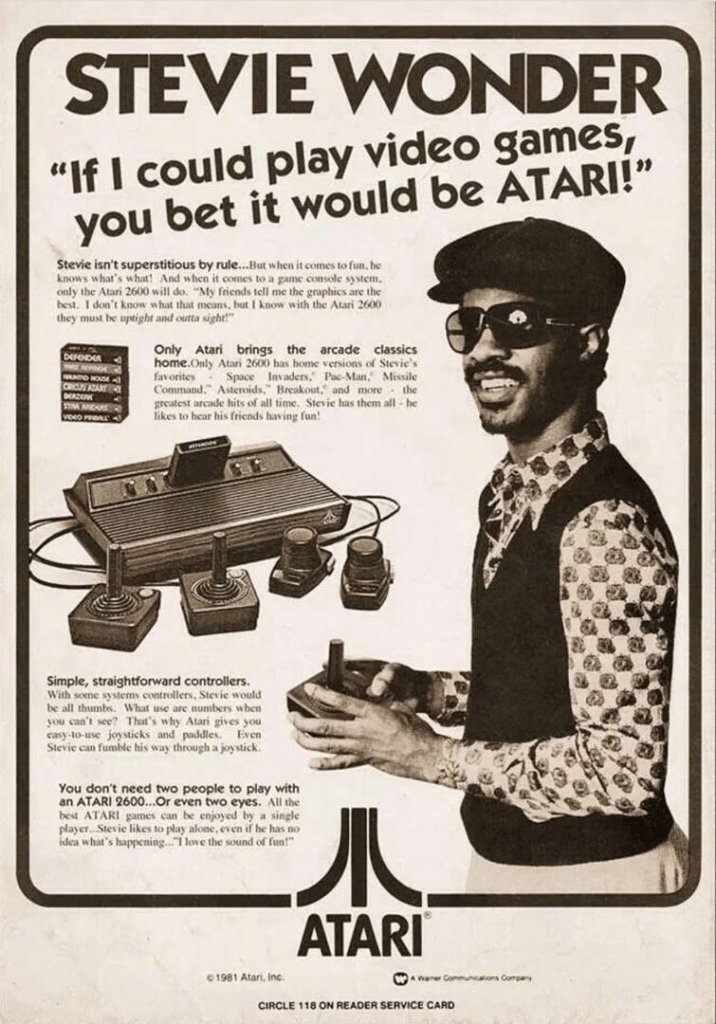
Commercials use ethos by getting celebrities to endorse products. Some use it correctly, and others don’t .
How writers can use it the correct way:
- Concrete, accurate detail
- Use specific details whenever possible
- Emotional restraint
- Consistent worldview
- Willingness to admit uncertainty
Example of great use of Ethos in a novel
- Chuck Palahniuk, Survivor:
Why does this work?
Does the narrator sound authentic?
What details stuck out to you?
Is there anything you don’t understand?
Writing Prompt (10 minutes)
Write a paragraph about something you know intimately. Do not explain why you are right. Let precision do the work. This could be a short on how to cook a meal or fix an engine. Write a one page piece on something you are a subject matter expert on. Use as much detail as possible.
Who feels that what you just wrote down isn’t very exciting? That’s why we need Pathos.
Pathos: An Appeal to Emotion. Why Should the Reader Care?
Establishing yourself as a subject matter expert isn’t enough if you want to win that argument we’re talking about. You have to appeal to your readers’ emotions. We have to be careful on how we do this. Example of the Wax Bullet War. Remember, humor is a great way to evoke emotions as well.
What it is
Pathos is emotional movement. Not melodrama. Not sentimentality. Actual feeling.
How writers create it
- Scene instead of summary
- Specific sensory detail
- Letting the reader connect dots
- Rhythm and sentence length
Micro-example excerpts (under 90 characters)
- “I turn my body from the sun… Am I cut off from the last fond pride of meanest shipwrecked captains? Oh, lonely death on lonely life! Oh, now I feel my topmost greatness lies in my topmost grief. Ho, ho! from all your furthest bounds, pour ye now in, ye bold billows of my whole foregone life, and top this one piled comber of my death! Towards thee I roll, thou all-destroying but unconquering whale; to the last I grapple with thee; from hell’s heart I stab at thee; for hate’s sake I spit my last breath at thee. Sink all coffins and all hearses to one common pool! and since neither can be mine, let me then tow to pieces, while still chasing thee, though tied to thee, thou damned whale! Thus, I give up the spear!
- “Talk not to me of blasphemy, man; I’d strike the sun if it insulted me.”
- “He piled upon the whale’s white hump the sum of all the general rage and hate felt by his whole race from Adam down; and then, as if his chest had been a mortar, he burst his hot heart’s shell upon it.”
Why these work
What do you feel?
What is Captain Ahab feeling?
Does the emotion in this piece make it stronger?
What do you understand about this character?
We can’t all be word masters like Melville, so that means the rest of us can’t solely rely on our amazing prose to get emotion across. While dialogue can take us a long way, we also can set a scene that will allow our reader to feel what we’re feeling. Part of the key is to recognize that everything you describe—a room, a car, the local park—is colored by your character’s mood. So you pick details that reinforce the desired emotion.
Writing Prompt (10 minutes)
Write a one page scene with a singular emotion in mind. Describe the setting, your character’s movements and dialogue with that one emotion in mind. It doesn’t have to be sadness or despair. The other end of the emotion spectrum is happiness and pride. Just pick one emotion and do your best to show us that emotion without writing it (or its synonyms) down in the piece.
Logos: Why the Writing Makes Sense
What it is
Logos is the internal logic of the piece. Events follow. Thoughts connect. Consequences exist. These are real (or sometimes imagined facts and small details). Using logos makes your reader connect the dots on their own many times. If you can make your reader come to your conclusions on their own, you will win the argument.
How writers use it
- Clear cause-and-effect
- Repetition with variation
- Thematic consistency
- List dates, times, locations, graphs, facts, and direct quotes – this is especially true when writing fiction.
Example excerpts Slaughterhouse Five by Kurt Vonnegut, part of Chapter 1
So we sat down. O’Hare was embarrassed, but he wouldn’t tell me what was wrong. I couldn’t imagine what it was about me that could burn up Mary so. I was a family man. I’d been married only once. I wasn’t a drunk. I hadn’t done her husband any dirt in the war.
She fixed herself a Coca-Cola, made a lot of noise banging the ice-cube tray in the stainless steel sink. Then she went into another part of the house. But she wouldn’t sit still. She was moving all over the house, opening and shutting doors, even moving furniture around to work off anger.
I asked O’Hare what I’d said or done to make her act that way.
“It’s all right,” he said. “Don’t worry about it. It doesn’t have anything to do with you.” That was kind of him. He was lying. It had everything to do with me.
So we tried to ignore Mary and remember the war. I took a couple of belts of the booze I’d brought. We would chuckle or grin sometimes, as though war stories were coming back, but neither one of us could remember anything good. O’Hare remembered one guy who got into a lot of wine in Dresden, before it was bombed, and we had to take him home in a wheelbarrow. It wasn’t much to write a book about. I remembered two Russian soldiers who had looted a clock factory. They had a horse-drawn wagon full of clocks. They were happy and drunk. They were smoking huge cigarettes they had rolled in newspaper.
That was about it for memories, and Mary was still making noise. She finally came out in the kitchen again for another Coke. She took another tray of ice cubes from the refrigerator, banged it in the sink, even though there was already plenty of ice out.
Then she turned to me, let me see how angry she was, and that the anger was for me. She had been talking to herself, so what she said was a fragment of a much larger conversation. “You were just babies then!” she said.
“What?” I said.
“You were just babies in the war — like the ones upstairs!”
I nodded that this was true. We had been foolish virgins in the war, right at the end of childhood.
“But you’re not going to write it that way, are you.” This wasn’t a question. It was an accusation.
“I — I don’t know,” I said.
“Well, I know,” she said. “You’ll pretend you were men instead of babies, and you’ll be played in the movies by Frank Sinatra and John Wayne or some of those other glamorous, war-loving, dirty old men. And war will look just wonderful, so we’ll have a lot more of them. And they’ll be fought by babies like the babies upstairs.”
So then I understood. It was war that made her so angry. She didn’t want her babies or anybody else’s babies killed in wars. And she thought wars were partly encouraged by books and movies.
So I held up my right hand and I made her a promise: “Mary,” I said, “I don’t think this book of mine is ever going to be finished. I must have written five thousand pages by now, and thrown them all away. If I ever do finish it, though, I give you my word of honor: there won’t be a part for Frank Sinatra or John Wayne.
“I tell you what,” I said, “I’ll call it ‘The Children’s Crusade.’ “
She was my friend after that.
O’Hare and I gave up on remembering, went into the living room, talked about other things. We became curious about the real Children’s Crusade, so O’Hare looked it up in a book he had, Extraordinary Popular Delusions and the Madness of Crowds, by Charles Mackay, LL. D. It was first published in London in 1841.
Mackay had a low opinion of all Crusades. The Children’s Crusade struck him as only slightly more sordid than the ten Crusades for grown-ups. O’Hare read this handsome passage out loud:
History in her solemn page informs us that the crusaders were but ignorant and savage men, that their motives were those of bigotry unmitigated, and that their pathway was one of blood and tears. Romance, on the other hand, dilates upon their piety and heroism, and portrays, in her most glowing and impassioned hues, their virtue and magnanimity, the imperishable honor they acquired for themselves, and the great services they rendered to Christianity.
And then O’Hare read this: Now what was the grand result of all these struggles? Europe expended millions of her treasures, and the blood of two million of her people; and a handful of quarrelsome knights retained possession of Palestine for about one hundred years!
Mackay told us that the Children’s Crusade started in 1213, when two monks got the idea of raising armies of children in Germany and France, and selling them in North Africa as slaves. Thirty thousand children volunteered, thinking they were going to Palestine. They were no doubt idle and deserted children who generally swarm in great cities, nurtured on vice and daring, said Mackay, and ready for anything.
Pope Innocent the Third thought they were going to Palestine, too, and he was thrilled. “These children are awake while we are asleep!” he said.
Most of the children were shipped out of Marseilles, and about half of them drowned in shipwrecks. The other half got to North Africa where they were sold.
Through a misunderstanding, some children reported for duty at Genoa, where no slave ships were waiting. They were fed and sheltered and questioned kindly by good people there — then given a little money and a lot of advice and sent back home.
“Hooray for the good people of Genoa,” said Mary O’Hare.
I slept that night in one of the children’s bedrooms. O’Hare had put a book for me on the bedside table. It was Dresden, History, Stage and Gallery, by Mary Endell. It was published in 1908, and its introduction began:
It is hoped that this little book will make itself useful. It attempts to give to an English-reading public a bird’s-eye view of how Dresden came to look as it does, architecturally; of how it expanded musically, through the genius of a few men, to its present bloom; and it calls attention to certain permanent landmarks in art that make its Gallery the resort of those seeking lasting impressions.
I read some history further on:
Now, in 1760, Dresden underwent siege by the Prussians. On the fifteenth of July began the cannonade. The Picture-Gallery took fire. Many of the paintings had been transported to the Königstein, but some were seriously injured by splinters of bombshells, — notably Francia’s “Baptism of Christ.” Furthermore, the stately Kreuzkirche tower, from which the enemy’s movements had been watched day and night, stood in flames. It later succumbed. In sturdy contrast with the pitiful fate of the Kreuzkirche, stood the Frauenkirche, from the curves of whose stone dome the Prussian bombs rebounded like rain. Friederich was obliged finally to give up the siege, because he learned of the fall of Glatz, the critical point of his new conquests. “We must be off to Silesia, so that we do not lose everything.”
The devastation of Dresden was boundless.
The two little girls and I crossed the Delaware River where George Washington had crossed it, the next morning. We went to the New York World’s Fair, saw what the past had been like, according to the Ford Motor Car Company and Walt Disney, saw what the future would be like, according to General Motors.
And I asked myself about the present: how wide it was, how deep it was, how much was mine to keep.
I taught creative writing in the famous Writers Workshop at the University of Iowa for a couple of years after that. I got into some perfectly beautiful trouble, got out of it again. I taught in the afternoons. In the mornings I wrote. I was not to be disturbed. I was working on my famous book about Dresden.
And somewhere in there a nice man named Seymour Lawrence gave me a three-book contract, and I said, “O.K., the first of the three will be my famous book about Dresden.”
The friends of Seymour Lawrence call him “Sam.” And I say to Sam now: “Sam — here’s the book.”
Why this work
Slaughterhouse Five is a book about some very big topics. War, life, death, how humans perceive time, how we grieve, space aliens, but Vonnegut grounds us right away with blocks of text taken from reference books.
- What sticks out about this excerpt?
- Why does Vonnegut quote these books?
- Does using facts, times, dates, locations, and names help the argument?
- How?
Let’s read a piece that has all three.
What was the argument here? Why do you believe Orwell wrote this piece?
Did he win the argument he was trying to make?
Let’s talk about Ethos first –
Where is the Pathos?
What about Logos?
Homework assignment
Revise one earlier prompt OR take an existing story or chapter of something you’ve written already and do your best to come up with an argument, a theme, a thesis, and use the rhetoric triangle to win that argument in whatever piece you choose.
- Add your own life experiences for ethos, even if you want to turn it into a scifi or fantasy novel. You can always use your own experiences.
- Do your best to appeal to your readers’ emotions.
- Use dates, times, full names, and direct quotes, even if you have to make them up.
Shoot for 1,000 words, edit it if you will, but bring it next week to workshop with the group.
Examples of Rhetoric in History and what it’s changed
1. Aristotle and the Formalization of Persuasion
When: 4th century BCE
What changed: Rhetoric stopped being “that thing clever guys do” and became a teachable system.
Aristotle didn’t invent persuasion. The Sumerians did. He dissected it. By naming ethos, pathos, and logos, he gave future speakers and writers a toolkit instead of vibes. This mattered because once persuasion became systematic, it became scalable. Courts, politics, education. Everyone suddenly had a shared operating manual for influence.
Impact:
People stopped thinking persuasion was magic or divine favor. It became craft. Which means anyone could learn it. Which is both empowering and terrifying.
2. Cicero and Roman Civic Identity
When: 1st century BCE
What changed: Public speech became a moral performance.
Cicero fused rhetoric with ethics. A good speaker wasn’t just skilled, he was supposed to be virtuous. That idea stuck around for centuries. The speaker as moral authority. The voice of the republic. The guy who sounds calm must be right.
Impact:
Western culture inherited the dangerous idea that eloquence equals goodness. We are still cleaning that up.
3. Martin Luther and the Printing Press
When: 1517
What changed: Authority shifted from institutions to text.
Luther’s rhetoric wasn’t subtle. It was direct, repetitive, emotionally charged, and written in the language people actually spoke. The printing press did the rest. Suddenly belief didn’t require priests to interpret Latin. You could read. You could argue. You could disagree.
Impact:
People started believing they could think for themselves about God. Which promptly snet Europe into an upheaval of normality. It began to change how governments and civilizations ruled.
4. Thomas Paine and Common Sense
When: 1776
What changed: Revolution became emotionally obvious.
Paine didn’t argue like a philosopher. He argued like a pissed-off neighbor who brought receipts. Short sentences. Moral clarity. Repetition. He framed independence not as radical, but as common sense. That phrase alone reframed the entire debate.
Impact:
Colonists stopped seeing rebellion as reckless and started seeing obedience as irrational. That’s a full cognitive flip caused by pamphlets.
5. Abraham Lincoln and the Gettysburg Address
When: 1863
What changed: The meaning of the Civil War.
Lincoln reframed the war away from territory and toward ideals. Equality. Sacrifice. Continuation of a moral experiment. He did it in about two minutes, with biblical cadence and almost no decoration.
Impact:
People began to see the war as necessary, even sacred. That reframing still defines American identity whether people realize it or not.
6. Edward Bernays and Modern Advertising
When: Early 20th century
What changed: Desire became manufactured.
Bernays took Freud’s ideas and applied them to selling stuff. He didn’t argue logically. He tied products to identity, fear, sex, and status. He turned rhetoric into psychological engineering.
Impact:
People stopped thinking of themselves as consumers making choices and started behaving like bundles of impulses waiting to be nudged. Congratulations, capitalism got smarter than us.
7. Martin Luther King Jr. and the Civil Rights Movement
When: 1950s–60s
What changed: Moral urgency became unavoidable.
King blended biblical cadence, constitutional logic, and emotional storytelling. Ethos from faith and restraint. Logos from law. Pathos from lived experience. All braided together.
Impact:
Segregation stopped being framed as “tradition” and became framed as injustice. Once language changes the frame, policy follows whether it wants to or not.
The Throughline
Rhetoric doesn’t just convince people to agree.
It changes what feels normal.
It changes what feels possible.
It changes what questions people even think to ask.
Which is why teaching writers ethos, pathos, and logos isn’t academic fluff. It’s teaching them how to rearrange reality with sentences.
Suggested Readings
- Chuck Palahniuk, Survivor (voice and moral authority)
- Kurt Vonnegut, Slaughterhouse-Five or essays (logic wrapped in irony)
- Ernest Hemingway, short stories like “Hills Like White Elephants” (restraint and implication)
Stormy River Writers
Welcome to Stormy River Writers in Astoria. Share your work, draft prompts, and weekly assignments with our community.
 Stormy River Writers Astoria, Oregon